Most architecture has a more or less utilitarian function (but good architecture always transcends a narrow strictly serving role!). There are also genres of architecture though, where practical utility is not even at the center stage, to begin with: The first one is the folly: an architectural work of art; an expression of spatial, material and formal play, with its own rules. Follies don’t serve a practical purpose; they are free from utilitarian notions of function. Follies might have minor casual uses such as viewpoint or meeting points in public spaces, but nothing that resembles the design brief of e.g. housing, offices, and museums. They are festive exercises in architectural playfulness and pleasure. The other genre is that of the sacral. Traditionally a place for the gods or spiritual experiences. Here too, practical functions are subordinate to non-utilitarian functions such as providing the conditions for awe, silence and contemplation, light and enlightenment, positive disintegration, and inner experience. What can be found in these worlds?
‘The Framing Experiment’ dives in the notion of ‘finding beauty within the ordinary’. It is about the sacrality of sunrays, a friendly smile or a good cup of tea on a rainy afternoon; sacrality can be found anywhere, you just have to look for it. In order to ‘prove’ this statement, a random grid is projected on top of Eindhoven. The lines create intersections, and pinpoints random locations. This is why it is called an ‘experiment’, to see, or to investigate, if sacrality can really be found anywhere.
Feeling of transcendence – Liliia Polukarova
In architecture, sacral spaces are primarily those connected with religion, memory, and the feeling of transcendence: churches, cemeteries, and memorials. However, the sacredness can be found in other architectural typologies, far from religious themes. The deepwater swimming pool, for instance, can be named a sacred space since the process of deep diving can give one a feeling of transcendence and help to calm one’s mind and body.
Temple of Realization – Sybrin Hendrikx
The temple of Realization emphasises the feeling of grandeur and immensity. With its sheir size, the temple dwarfs its visitors, emphasizing they are but a small part in a much larger universe, larger than they can grasp. Taking both inspiration from the works of Piranesi and Boullée, this project focuses on the aspects of Grandeur, embracing the universe, as well as immensity, feeling overwhelmed. Through a gradual pace and layout of the temple, this immensity transitions to grandeur, reflecting the spiritual process of realization.
The Sacral of Inner Reflection – Tommy Wijkmans
This folly is designed with a deconstructivist motive. The result is an edifice that undermines the roof as an architectural element to reveal that it is built on unstable grounds. The folly is all about hiding and revealing its structure. The mutated structural grid, different orientations of planes and conflicting materials create a playful composition of light and shadow. The black staircase has a clear direction without a visible ending, creating a sense of curiosity to explore the folly.
Sacral
The Boundaries of a Roof – Daan Hegeman
This building is a place for inner reflection, where the mind can turn inward. Scale, light and shadow, visual stimulation, and the ability to induce wonder all promote reflection. Daylight enters the outer corridor through large windows. The randomly placed beams stabilize the floating inner structure and create a play of shadows changing throughout the day. One can sit in the reversed vaults and watch the ballet of shadows. In the central space, the floating inner structure mocks gravity, with no parts touching the floor.
The Masque of Normality – Juultje van der Linden
‘The Masque of Normality’ plays with perception, assumption and prejudice; exploring the ways we understand spaces and grasp reality. Things may seem ‘normal’, but this could also be a mask. But what is normal? What we perceive as reality is nothing more than a construct of our minds. The ‘Masque’ has a height of 90m; it is enormous. However, by playing with perspective, it will look like a small house on the hill from far away. Behind this façade is the parasite, taking over the ‘normal’.
Game, Mystery, Romance – Liliia Polukarova
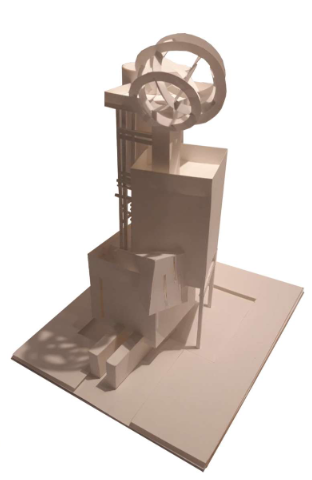
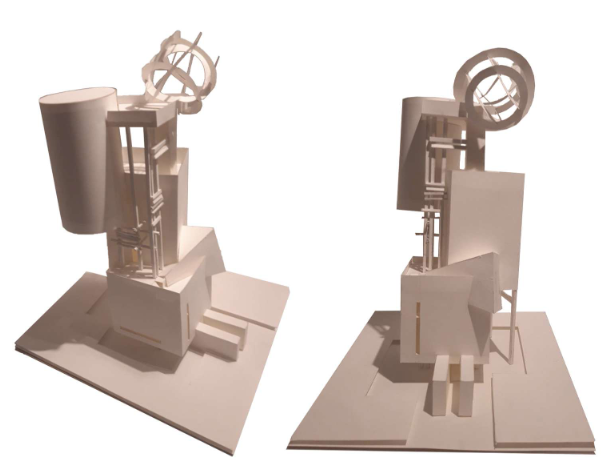
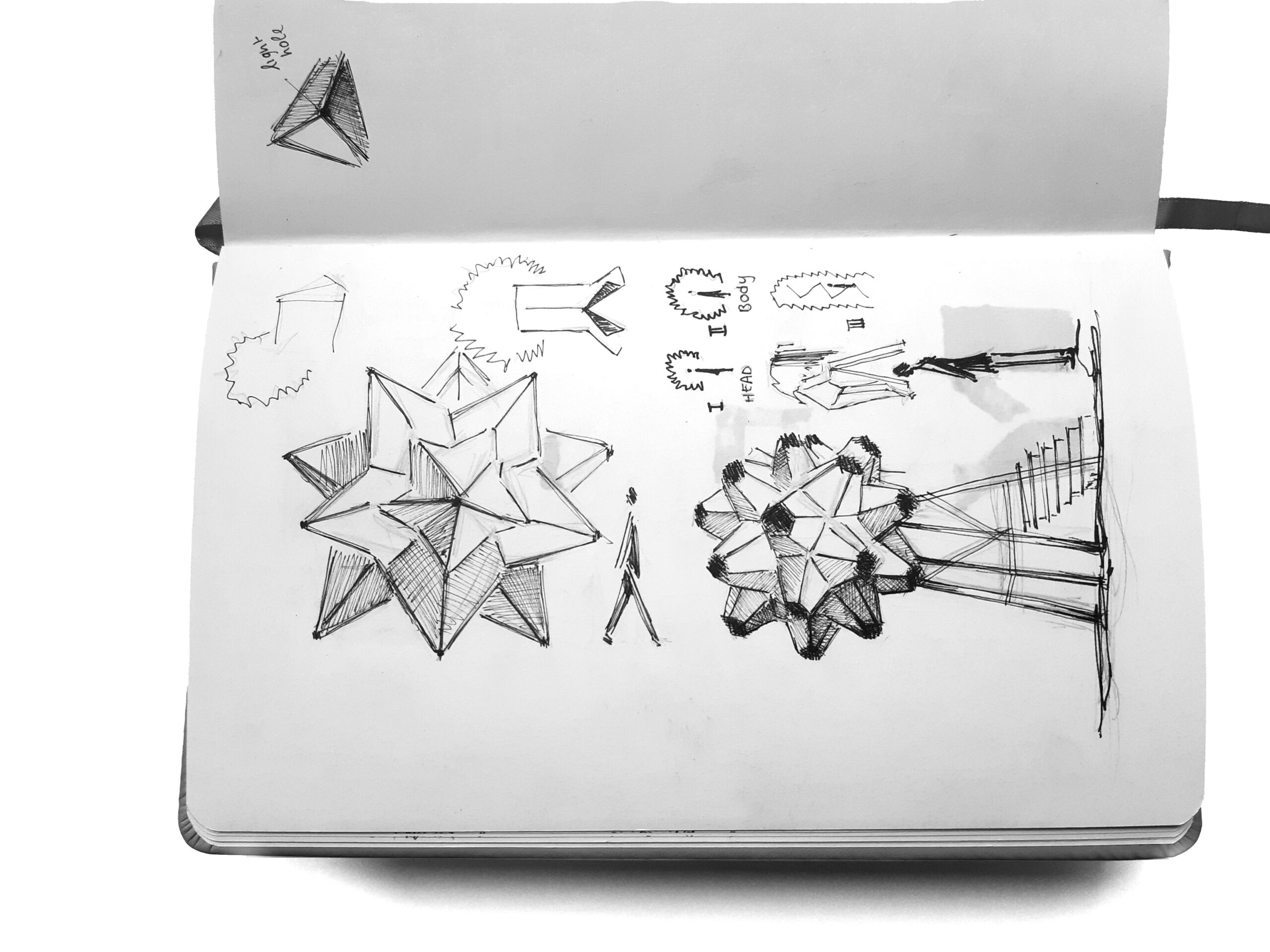
Folly (from French folie, “foolishness”), also called eyecatcher, in architecture, a costly, generally nonfunctional building that was erected to enhance a natural landscape and create the atmosphere of game, mistery, romance. The project is a tower combined of different volumes, i.e., follies, every volume expressing the name of the TU/e building, which are as follows: Vertigo, Atlas, Metaforum (or Meta), Matrix, Flux, Neuron, Luna, Gemini.
The Art of Noticing – Annemijn Smulders
The ‘Art of Noticing’ is all about reconnecting people with their surroundings. There is so much untapped wisdom on the streets all around us, we’re just often not looking around to take it all in. This installation is designed to make people aware of things they’ve otherwise been ignoring. It’s a place where people can pause and hopefully contemplate their surroundings as an active observer rather than taking it for granted in their daily, passive routine. It’s a place to pause and ponder, a distinction between looking and seeing.